Thursday, October 22, 2020

North American History - Annotated Bibliography

North American History - Annotated Bibliography

    1 https://www.timelineindex.com/content/select/1433/45,1340,1433  Excellent timeline combined with identification of 437 items.   *Note: when expanding entries, the timeline shifts to other categories.  Return to previous entry before continuing, in order to stay on task and on topic. ** This is not a scholarly source, it links Wikipedia for further research.  Thus, TimeLineIndex is a starting point, but all information needs to be referenced with three sources (that do not reference each other) for accuracy.

    2 

Tuesday, June 5, 2018

Identify (ID): The Peloponnesian War

Explanation:
     A testing method for history students is the ID or "identify" a person or event from history in as little as two sentences. Keep the IDs very concise, and save your time for the longer essay(s). Study for your exam by rewriting these IDs after each lecture ("revision notes") and reviewing them by the "spaced-repetition" method.

Example:
     The Peloponnesian War  (431 B.C. to 404 B.C.) was a series of battles between Sparta and her allies versus Athens and her allies in the region of Greece. The Athenian general and historian, Thucydides, wrote volumes on the Peloponnesian War of which he was an eye-witness until he was exiled. Sparta and her allies won. 
    Grade: With the assumption that an exam would be taken in a proctored room and written out with pen on paper, the order of the sentences would not be editable, but an arrow could be inserted if done neatly.  The above ID example would earn likely lose two to three points for attaching a Thucydides ID in sentence two instead of explaining the cause of the war, the method of warfare, and the resulting significance.= 2/5

Sunday, December 31, 2017

Lunar v. Solar calendars

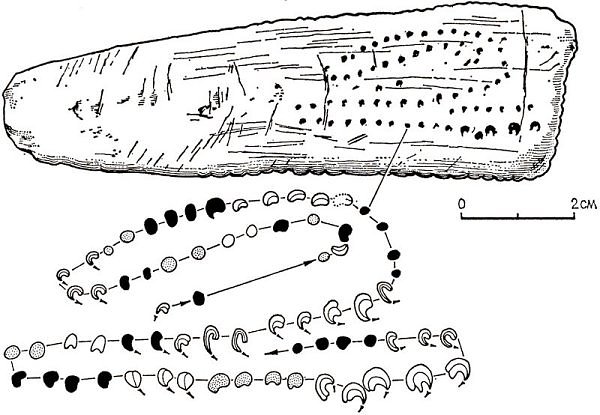
    The oldest lunar calendars were found in caves in France and Germany. One such lunar "chart" was marks made on an animal bone, and another on the wall of a cave.2,3

    The first recorded change from lunar to solar calendars was made by the Egyptians. The rise of the Sirius above the horizon, just before dawn, indicated when the Nile would flood.1 The solar calendar of 365 days and 6 hours. "Instead of 32 years with the moon, it is 1460 years before Sirius rises again on the first day of the first month."1, 4
Image result for sirius at sunrise in egypt
Sirius 

      Twelve lunar months make up 354 days. The a lunar calendar is eleven days shorter than a solar calendar year. The Muslim calendar rights itself every 32 years. The Babylonians, Roman Republic, and the Jewish calendars add(ed) a month to make up for the shortage. 1
      "The lunar month on the Jewish calendar begins when the first sliver of moon becomes visible after the dark of the moon. In ancient times, the new months used to be determined by observation. When people observed the new moon, they would notify the Sanhedrin. When the Sanhedrin heard testimony from two independent, reliable eyewitnesses that the new moon occurred on a certain date, they would declare the rosh chodesh (first of the month) and send out messengers to tell people when the month began."5 Festivals and religious holidays always occur on the same Jewish calendar day, unlike the civil calendar.5

http://www.historyworld.net/wrldhis/PlainTextHistories.asp?historyid=ac06
https://sservi.nasa.gov/articles/oldest-lunar-calendars/
3 Aurignacian Lunar Calendar(image) from source 2
4 https://tse1.mm.bing.net/th?id=OIP.ZfCeNQdINfGJ7QpAYVppwgHaHI&w=92&h=105&c=8&rs=1&qlt=90&dpr=1.090909&pid=3.1&rm=2  (image of Sirius)
5 http://www.jewfaq.org/calendar.htm


Sunday, November 12, 2017

Century Anniversaries 2017

500th Anniversary of the Protestant Reformation in Europe (a Catholic reformation followed in response to the Protestant Reformation.  Martin Luther was a key figure of the Protestant Reformation; he nailed his 95 Thesis to the Castle Church door of Wittenberg on October 31, 1517.
http://www.pbs.org/program/martin-luther-idea-changed-world/
http://www.luther.de/en/95thesen.html
http://www.luther.de/en/anschlag.html

100th Anniversary of the Bolshevik Revolution in Russia (Communism)
http://nation.com.pk/08-Nov-2017/100th-anniversary-of-the-bolshevik-revolution-in-russia
https://www.biography.com/news/russian-revolution-100th-anniversary-facts

Tuesday, September 26, 2017

Seven Wonders of the Ancient World


I.                    Pyramid of Giza
The Pyramids on the Giza Plateau are located on the edge of Cairo, Egypt.  The Great Pyramid at Giza is the only surviving “ancient wonder”. The Great Pyramid took 23 years to make and was completed in 2560 B.C.  It is the largest of 80 pyramids in Egypt, with a height of 480 feet. It was covered in quality limestone, that was stripped away to rebuild Cairo.
II.                  Hanging Gardens of Babylon
The Hanging Gardens of Babylon were created as a surprise gift from King Nebuchadnezzar II for his queen, Amytis of Media.  Babylon was a city on/near the Euphrates River. The location of the Euphrates has changed during the last 7,000 years.  It is hypothesized how the gardens were watered. 
III.                The Statue of Zeus at Olympia
The statute of Zeus was created in the first century AD. The ivory was fastened over a wood frame.  A secret method was used to soften the ivory.  Special techniques were used to shape every detail.  The seated statue of 45 feet in height took seven years to create, before it was installed in the temple at Olympia.
IV.                Mausoleum at Halicarnassus
The Mausoleum at Halicarnassus was the elaborate tomb of the Persian Satrap (governor) Mausolus (who married his sister Artemisia). Pitheus built the 14 story building with twice life-sized statues and various building styles from different countries. This is the first, known, building to have a statue put on top. A fifteenth century earthquake destroyed the mausoleum and the remaining materials were used to make cement.
V.                  The Temple of Artemis at Ephesus
The Temple of Artemis, the second or three built on the same site. It was commissioned by King Croesus of Lydia and begun in 550 BC.  The building was almost twice the size of the Parthenon with 126 -60’ columns entirely of marble.  It took 50 years to finish by the architect and his son.  Iron tools were used.  The temple was destroyed by arson, when the wooden roof and interior stairs burnt a column fell and the temple collapsed. Within seven decades temple was rebuilt.1,2
VI.                The Colossus of Rhodes
The Colossus of Rhodes was a giant bronze statue of the sun god, hellos.  The victory statue was 120 feet tall and loomed over the harbor site. The frame of the statue was wood and iron with rocks added inside the base for support. It was built on-site with a 100’ sand/dirt ramp spiraling up from the ground around it during its construction. The 225 tons of bronze plates were riveted into place.  It took 12 years to build, lasted 56 years, and toppled in an earthquake in 226 BC. It was left broken for 900 years because of an oracle that said if it was rebuilt then Rhodes would be destroyed.
VII.              The Pharos of Alexandria
The Pharos, lighthouse, of Alexandria was 400+ feet high and its beam could be seen 50 miles out to sea.  It was the first skyscraper.  It was built during Ptolemy II’s reign by the Greek engineer and architect Sostratus of Cnidus. Vast furnaces were kept burning and bronze reflectors directed the light.  It is believed that a spiral ramp inside allowed donkeys to carry the fuel for the furnaces.  A remarkable feat of engineering considering that the walls had to withstand all the weight of above. In 1303 an earthquake toppled the lighthouse.  It is now studied by marine archeologists.

Cite: DVD The 14 Wonders of the World: Ancient and New.
2 http://www.softschools.com/facts/wonders_of_the_world/temple_of_artemis_at_ephesus_facts/69/